

You Matter is a non-crisis peer support and resource line for 2SLGBTQ+ community members in Calgary, run by Calgary Outlink. The support line launched on September 6th, 2022, and is operated by Outlink volunteers. You can call about anything you’re looking for support with, including identity, relationships, coming out, transitioning, community, resources, and more!
How to reach the line
Call or text: (587) 800-4121
Online chat: Click on the chat window at the bottom of any page on our website to chat with a volunteer.
Who is the line for?
The line is open to callers of any age and identity who are looking for support or resources.
Please note that this support line is volunteer-run. Depending on volunteer availability and how busy the line is, you may need to try contacting the line again later or on another day if your call, text, or chat isn’t answered.
Our policies, such as our Confidentiality and Safer Spaces policies, apply to this service, as with all of our services.
Further support
As stated above, this is a non-crisis peer support line. If you’re experiencing a crisis, please reach out to the crisis support lines below.
Distress Centre: 403-266-HELP
9-8-8 Suicide Crisis Helpline: call or text 9-8-8
Kids Help Phone: 1-800-668-6868
Our funders
The You Matter 2SLGBTQ+ Peer Support & Resource Line has been made possible with funding from the Calgary Foundation, the Chinook Fund, the Government of Alberta, and the Canadian Women’s Foundation. We are honoured to receive support through these funders that helped make this project a reality.
Organization Spotlight
Bellamy van Aalst (they/them) Founder of Violet's Book Club
Published On: August 24, 2023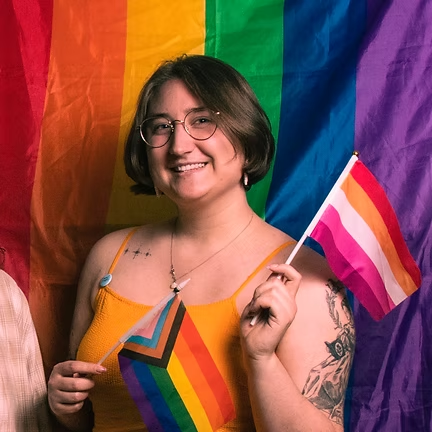 I am the creator and organizer behind Violet’s Book Club. We have been active for about a year.Sapphic book club.
Violet’s Book Club exists because, honestly, I was feeling really disconnected from the queer community in Calgary and I wanted an excuse to meet people, really. I read a lot, so I kind of use that as my [jumping-off] point of having something in common with people, and as a reason for why we would come together.
Another reason I wanted a book club specifically, [was that] a lot of queer spaces are out until really late at night, or center on dancing. I love going out, I love dancing, I love staying out late, but I also love meeting with queer people at 1:00 PM in the park doing something chill.
My two favorites are Everyone in This Room Will Someday Be Dead by Emily R. Austin, and the other one is Butter Honey Pig Bread by Francesca Ekwuyasi. Those are two of my favorite books of all time.
Honestly, I see us doing the same thing: reading books, meeting (hopefully still) once a month, just hanging out. Very occasionally I organize things like lunches, rock climbing, or hangouts. We have a discord group, and people will message, “Hey, does anyone want to come read with me at this café?”
I see that still happening, people connecting outside the monthly meetings. Hopefully we’re still just hanging out!
Queer voices have been smothered long enough, and we are working on building a community that wasn’t allowed for so long. There’s a couple different ways that [Violet’s Book Club] pertains to that.
One is through the books themselves, reading diverse stories that people haven’t heard of before. We read a lot of books by people of color, people of different backgrounds that a lot of members wouldn’t have any other experience with, and they gather that exposure through the books.
We [also] get to sit as a group, people from all different backgrounds, abilities, ethnicities, and sexualities to discuss what we read that month. Then we usually spend an hour hanging out, making friends, talking about [our] personal lives. It’s really [about] opening up, meeting new people, being able to talk about your experiences, and being able to relate to these stories – whether that’s very closely, or in a more distant fashion.
My go-to answer is that I love to read, but I [also] love to spend time with the people I care about. I love to build community in general. I like to spend time in the sun – I love Riley Park. It’s where most of our summer meetings are because it’s my favorite.I noticed a shift in the past year [with] a lot of queer spaces right now. When I started this club, a lot of queer places in Calgary were not very accessible. Whether that means ticket or entry fares were expensive, meeting places are up stairs, it happens really late at night, it’s centered around drinking alcohol, or a combination [of those]. I love going out partying, but I think it’s important to create spaces that are more accessible to as many people as possible while still keeping it limited to the [idea that] “something accessible to all is accessible to none.”
We need spaces for queer people that are either sober, or physically accessible, and there wasn’t a lot out there. I think that’s incredibly important.
My space is 18+. I did that specifically because I was 22 when I started the club, and I think it would be inappropriate to hang out socially with a 15 or 16 year old. I would love to see something out there made for teenagers in the same regards of what I’m doing. That was another way of making it a safe space.
I try to make the meetings physically accessible. If it’s a picnic [meeting], I provide food. I provide bookmarks for free. We vote upon the books. If someone suggests a book that I know is inaccessible (i.e. they don’t have any copies at the library, or it’s a brand new book that costs $40 in store), I don’t put that in the poll so that the book of the month is accessible. If you can’t afford the book, then how are you going to comfortably come to the meeting? I encourage people to come, even if they won’t read the books, because we just spend an hour hanging out. [But] I really make sure that I don’t include brand new books.
I would love to briefly talk about why I chose the name. Violets [are] a historically sapphic flower. It appears in Sappho’s poetry. There was a play that happened in the 1920s. There were lesbians in this play, and people hated that. So lesbians and supporters wore a violet pin on their lapel in support. (Note: The play referred to here is The Captive by Édouard Bourdet, first premiered in 1926. The story follows Irène, engaged to a man, but is in love with another woman. Violets are used as a symbol of love between the two women.)
Flowers have such a strong historical queer background, like pansies, violets, lavender. I think it’s so beautiful and it should be cherished. I chose ‘Violet’ specifically because of its sapphic background.
Anyone is welcome in this club who feels like they identify under the sapphic umbrella. I myself am nonbinary. I don’t believe you have to be a cis lesbian to join. You can be whatever you want, as long as you feel comfortable under the sapphic umbrella.
You can follow Violet’s Book Club on Instagram: @violetsbookclub to stay up to date on what they’re reading for each meeting. Bellamy is also co-founder of Lavender Club YYC. To learn more about the group, check out our previous interview with their fellow co-founder Amanda.
Further reading:
Medhurst, Eleanor. “From Lavender to Violet: The Lesbian Obsession with Purple.” Dressing Dykes, 20 August 2021.
Volunteer Spotlight
CATHERINE (she/her) - Peer mentor
Published On: August 10, 2023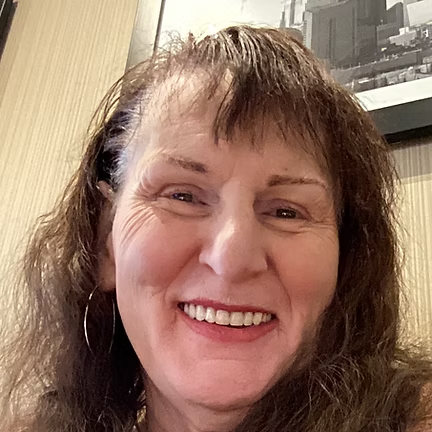
In December of this year, I will have been on this planet for 70 years. Every time I actually think about it, it still drives me crazy, because six months ago, I was 25. Believe me, time flies. Background-wise, I knew something was not the norm. This was back in the 50s. Before I even started school, I started wearing my mom’s clothes. At five years old, you don’t worry about whether or not there is a label to describe [yourself]. As time went by, I labeled myself as a cross-dresser, and I did [for] my entire adult life up until January 2015.
In January 2015, I was paragliding down in Bucaramanga, Colombia. On January 30th, I made three short flights in the morning. My next memory is just over a week later in the Medivac flight back to Calgary. I had flown [the] wing [of] my paraglider into a set of power lines directly adjacent to where we launch. I fell the better part of 70 ft and broke my entire body – crushed my pelvis, broke my back, massive concussion. All sorts of stuff that ended up with me being 3.5 months in [a] hospital in Calgary. While I was lying on my broken back, I realized that my 60 years [of life] had been a lie. I’m a woman, and I had been touching whatever little bits [of it], calling it cross-dressing simply to get through each day.
I went under the knife three times while still in Colombia. Each time, the surgeon said to Gordon [my emergency contact] that they did not know if I was going to wake up from all three operations. The realization [was like] an epiphany. I thought, “I’ve lived the first 60 years as a lie. I am not going to live the next 60 as a lie.”
Now, that’s a bit of a positive attitude, that I’ll make it to 120. But, Catherine became real and the acceptance [of that] has been wonderful.
I was put into a group, TransJourneys. They offered me a safe place and were helpful on many different levels. At that point, I had already been almost completely through the physical transition. I’ve received a whole bunch of support. I figured it was time to give back.
When the opportunity to mentor [at Outlink] came up, I was all over it. [Along with] doing the mentorship training, I have volunteered for a few casino [fundraisers].
I’ve done a number of presentations to groups over the last eight years, including one that I just did down in Fort Calgary. The mayor was at it, [and] I was one of four panelists. I was there representing Rainbow Elders as [a] moderator. We were asked to share something relevant to aging. I started off saying to the group that there was a belief of mine that they were going to hear a dozen times more: Respect everyone.
I can tell [that] everyone I have interacted [with] at Outlink has exactly my attitude and belief. Human beings, simply by being human, are entitled to respect. Having benefited from help from so many resources, and wanting to give back, [volunteering at] Outlink was the way to do it.
At this point, I have only mentored one person. [They were] a young transgender person. The trust I was given by them was huge. I was absolutely non-judgmental in my capacity as a mentor, [acting as] someone there to help. They were having trouble making ends meet and [they were] very young. They were going to [engage in] sex work. I had peripherally been aware through listening to people at TransJourneys, [about] the difficulties they were experiencing. This just really brought it home.
As a mentor, you have to be an active listener. The first thing that came to mind was, “How do you ensure your safety? Have you thought of what might heighten your safety?”
Working through that entire portion, [it was an] eye opener. As an adult, I’ve got 50 years of life experience that gives me a whole bunch more ammunition in the battle when something untoward happens. I’ve got stuff that I can dig deep [to] gather myself, and then withstand whatever the incident might be. When you’re 30, let alone [in your] early twenties, you don’t have the legs to stand on. You don’t have the comparison from life experience. When [I was] put together with [my mentee], I know how to listen, [whether you’re] 20 or 80.
As I always say: If you want to paint your belly button blue, go right ahead. [But] don’t ask me to paint mine blue. I’ve got things that I do, like my woodworking. [Some people are] like, “How can you spend that much time, that much money, just to make wood dust?”
That’s their attitude, their belief. I am not forcing them into my shop, nor do I expect the belly button painter to force me to do [that]. [It] goes back to that first word – respect.
Decisive; never quit.Gordon Lightfoot – one of his lesser-known songs is called “Wherefore and Why.”
[I have] two all-time favorite movies. The original Music Man (1962). [The main lead] is a salesman in Iowa, coming in selling the concept of boy bands. He gets people to buy uniforms, instruments and everything. [The lead actress] is the town librarian. It’s a musical – I am a lifelong musician. Professionally, trumpet, flute, and guitar are my three main instruments. I play and teach all three. The whole movie [has] tremendous quality music in it [that] just really speaks to me.The other movie is The Princess Bride (1987). Do you remember the sword fight [scene]? I think that’s the best ever.
[As for] hobbies, remember the three words I gave – never quit? I don’t do anything halfway. I started [playing the] trumpet at six. In 1970, the World Expo that year was in Osaka, Japan. I [was] living in British Columbia. [The province] put together a full 55-piece concert band from all over the province. It was a highschool to college age group, and you had to be recommended to even apply to be tested to see if you would make it in the band. There were 200 trumpet players who applied for trumpet and cornet. There were two trumpet positions and six cornet positions. I not only made it, but I was picked as the solo cornet player in the band for the trip to the World Expo.I made my first skydive right around the end of October 1984, and then 3.5 years later as team captain of the Canadian national team. We went to Australia for the World Championships – which we won. I spent eight years as a competitive skater, dance and free dance. Never competed outside the country, but I have national medals. [I also do] archery. I’m a certified scuba diver.
I am also a competitive shooter. I [was] competing fifteen years ago in Red Deer. The nationals were there that year. I won in my category, and that was indoor 10 meter air pistol.
One of the joys of being on the planet for a while [is that] as long as you keep your mind open, you get to experience a whole pile of new stuff. I’ve never had the attitude of, “Oh, I can’t do that.”
[For] people that label it as “just a hobby,” I feel sad for them. If it’s “just” a hobby, you’re not experiencing life. They are dabbling in life; they are not jumping in [with their] full body.I am married. My wife, Sherry, [and I] had our 21st anniversary on March 21st. 20 years ago, when [we] started going out, she met “Catherine” half a dozen times before she met my male persona, and [she] was 3 000 000% supportive.
Everyone, you and I included, have quirks that contribute to making us individuals. I’ve heard that if you’re not prepared to grant your friends one iota of idiosyncrasy, craziness, or whatever, you’re never going to have any friends.
She and I come at stuff very differently. We have clashed many times. She continues to support me. For each of my medical transition procedures, I asked if she’d be able to take care [of me] once I got out of the hospital. [It] was not even a question. Top and bottom surgery, she was here. [She] drove me to and picked me up from the airport.
We are still a couple, still married. I’ve been married three times. My first two [marriages] ended because of my cross-dressing, let alone any transgender stuff.
I’ve had a number of friendships who, when I transitioned, made not one iota of difference in our friendships. I’ve got Ian, John, Gordon, Marco, Michelle, Melvee. I’ve been blessed with friends that are fringe to the level that if I’m [wanting] a “holy shit,” experience moment, they’ll be there.
I have been asked, on at least a few occasions, “Did you ever have suicidal thoughts?”
Not only [is my answer] no, but for myself intrinsically, I can’t even imagine wanting to end it. There have been some fairly substantial occurrences. One year, I lost my wife, I lost my dad (he passed away), I lost my home, I lost my job, and I was diagnosed diabetic – [all in the] same year. My take on it was, “Oh shit, that was a bad year,” [and I] moved on, rather than thinking, “Oh well, after all that, life is not worth living.”